Water spots are one of the most common — and most misunderstood — paint problems Houston car owners deal with. What looks like a simple cleaning issue is often a form of actual paint damage. And in Houston, the conditions that cause water spots are nearly impossible to avoid without the right protection in place.
This guide covers exactly what water spots are, why Houston’s water is particularly aggressive, when spots can be wiped away versus when they require professional correction, and what the most effective long-term solution actually looks like.
What water spots actually are
Water spots form when water sits on your car’s surface and evaporates — leaving behind the minerals it carried. The water itself disappears. The minerals don’t.
Houston’s tap water and irrigation water carry two primary culprits:
Calcium and magnesium carbonates — the minerals responsible for hard water scaling. Houston’s municipal water comes primarily from surface sources (Buffalo Bayou watershed, Lake Houston, and Barker Reservoir), which carry significant dissolved mineral loads. When that water hits a warm surface — and Houston surfaces are warm for roughly nine months of the year — it evaporates fast, concentrating those minerals into a small deposit.
Silica and iron particles — carried in atmospheric moisture, sprinkler overspray, and roadway runoff. These form a second category of spots that look similar but require different treatment.
The result is a white, hazy, or crystalline deposit that bonds to your clear coat. When the deposit sits long enough — especially under Houston’s ultraviolet intensity — it begins a chemical process called etching. The minerals react with the clear coat surface at a microscopic level, creating a physical depression that cannot be wiped away. At that point, the damage is no longer on the surface. It is in the surface.
Why Houston is particularly hard on car paint
Three factors make Houston one of the most demanding environments in the country for exterior paint:
Hard water throughout the metro area. The Harris County area consistently records water hardness in the 130–180 ppm range — well above the 60 ppm threshold considered “soft.” Every sprinkler, automated car wash, and rain event deposits this mineral load onto your paint.
Heat-accelerated evaporation. A water droplet that might take 20 minutes to evaporate in Minnesota evaporates in under 5 minutes on a Houston vehicle sitting in direct sun. Faster evaporation means faster mineral concentration and faster bonding.
High UV index. Houston’s latitude and Gulf Coast humidity combine to produce UV index readings of 8–11+ for most of the summer. UV radiation accelerates the chemical reaction between mineral deposits and clear coat, turning surface deposits into etching faster than they would in a less sunny climate.
Frequent irrigation overspray. Nearly every commercial property, HOA community, and office park runs irrigation systems that regularly mist vehicles in parking lots. Irrigation water is often harder than municipal tap water, as it may pass through additional mineral-laden soil before reaching sprinkler heads. A car parked at the same office lot five days a week can accumulate significant mineral deposits within a single month.
The three stages of water spot damage
Understanding where your spots fall in this progression determines what treatment they actually need.
Stage 1: Surface deposits (no damage yet)
Fresh mineral deposits that have not yet etched the clear coat. The spot sits on top of the paint and has not altered the surface structure. These can often be addressed with a proper wash and a dedicated water spot remover or diluted distilled white vinegar solution applied carefully.
The window for Stage 1 spots in Houston is short — measured in days, not weeks. High heat and UV dramatically accelerate progression to Stage 2.
Stage 2: Light etching
The mineral deposit has begun chemically reacting with the clear coat. The surface has micro-depressions that catch light differently than surrounding paint. You can feel a slight texture difference with your fingernail. Wiping away the mineral deposit leaves behind the etch.
Stage 2 requires paint decontamination and light machine polishing to remove. This is professional detailing territory — attempting DIY correction with the wrong products or abrasives can create additional marring.
Stage 3: Deep etching
Prolonged exposure has created visible depressions in the clear coat. The etch is clearly visible in direct light and may penetrate through the clear coat toward the base coat in severe cases. This is paint damage that requires paint correction — a multi-stage machine polishing process using progressively finer compounds.
In extreme cases, where etching has burned through the clear coat entirely, repainting or clear coat respray becomes necessary.
What doesn’t work — and why
Houston car owners frequently attempt several approaches that either don’t work or make things worse:
Regular car wash soap. Car wash soap is formulated for surface dirt and road grime. It is pH-neutral by design (to protect wax and sealant layers). Mineral deposits require acid-based chemistry to dissolve, and car wash soap provides none. Running your car through a wash will move the minerals around. It won’t remove them.
Rain. A common belief is that rain will wash away water spots. Houston’s rain carries dissolved pollutants and acid compounds from the Gulf Coast atmosphere. More problematically, rain does not contain distilled water — it carries its own mineral load. A rain shower on a car with existing spots typically adds another mineral layer.
Household glass cleaner. Products like Windex contain ammonia, which attacks wax and rubber seals. They may temporarily improve the appearance of surface spots but cause collateral damage and don’t address etching.
DIY clay bar without lubrication. Clay bar treatment is effective for embedded surface contaminants but requires proper clay lubricant to work safely. Dry claying on mineral deposits causes marring on soft Houston clear coats.
Professional water spot treatment
When water spots have progressed past wiping away with a microfiber and proper spot remover, professional detailing is the right call. Here’s what an effective treatment protocol looks like:
Chemical decontamination: A pH-balanced iron remover is applied first to dissolve embedded metallic particles. This is followed by a clay bar treatment with proper lubricant to mechanically decontaminate the surface and pull up bonded mineral deposits that the chemical step loosened.
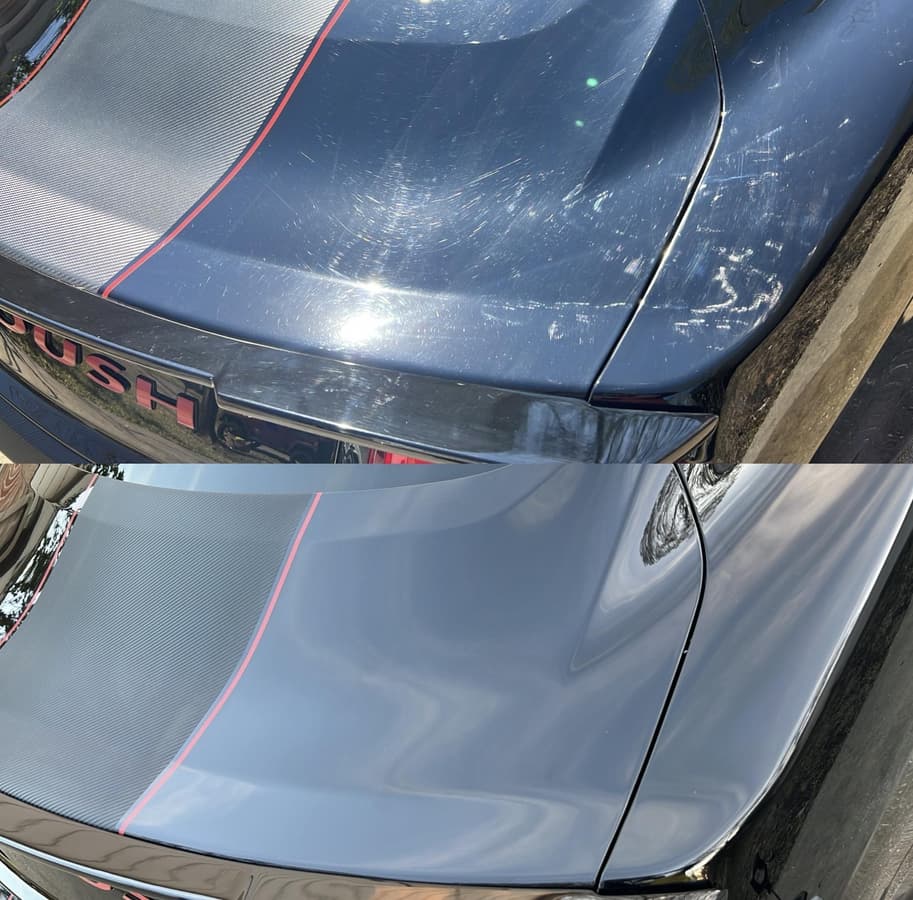
Paint correction (Stage 2–3 spots): For etched surfaces, machine polishing with a dual-action or rotary polisher removes a controlled layer of clear coat to level the surface below the etch depth. This requires proper equipment, proper compounds matched to paint hardness, and experience knowing how much correction each area can safely accept.
Surface inspection under lighting: Proper water spot correction should always be evaluated under dedicated LED panel lighting that reveals surface texture and remaining imperfections. What looks clean in open sunlight may still show etch patterns under panel lights.
Protection application: Corrected paint is unprotected paint. Immediately after correction, a protective layer — wax, sealant, or ceramic coating — should be applied to seal the exposed surface and protect against immediate re-contamination.
The permanent solution: ceramic coating
Treating water spots after they form is reactive. The more effective approach is making your car’s paint surface resistant to water spot formation in the first place.
Ceramic coating is the most effective long-term solution to Houston’s water spot problem. When a ceramic coating chemically bonds to your clear coat, it creates a hydrophobic surface that dramatically changes how water behaves on your paint.
On uncoated paint, water spreads into flat droplets, maximizing surface contact and mineral deposit area as it evaporates. On a ceramic-coated surface, water beads into tight spheres with minimal contact area. Water sheets off the surface rather than sitting. When the car moves — or when you spray it with a hose — water pulls those beads off the surface rather than leaving them to evaporate and deposit minerals.
The result: far fewer spots form. Those that do form are easier to remove because they’re sitting on the ceramic layer rather than on the paint. And routine maintenance washes become dramatically easier because the hydrophobic surface resists bonding with minerals, bird droppings, and road grime.
A properly applied ceramic coating in Houston typically lasts 3–5 years with proper maintenance — making it a cost-effective investment when compared against repeated paint correction services to address accumulated etching.
For Houston vehicles, we include paint decontamination and a single-stage correction pass as part of the Transformation package before coating application. Applying ceramic coating over contaminated or etched paint locks those defects in permanently — proper surface preparation is non-negotiable for a coating to perform correctly and bond properly.
How to reduce water spot accumulation between details
Even without a ceramic coating, some practices reduce water spot damage significantly:
Park strategically. Avoid parking beneath sprinkler overspray zones — the common culprits are commercial parking lots where irrigation systems hit vehicles. Parking in garages eliminates rain and dew exposure.
Dry your car after washing. Never let your car air-dry after a hand wash or drive-through wash. Blow-drying or towel-drying with a clean waffle-weave microfiber eliminates the evaporation step where minerals deposit.
Quick detail spray after rain. A spray detailer or waterless wash product applied after rain and dried with a microfiber removes surface mineral deposits before they bond.
Use a water spot remover promptly. Keep a pH-safe water spot remover in your car for situations where you cannot wash immediately. Applying it to fresh spots within 24–48 hours catches them at Stage 1, when removal requires no professional intervention.
When to call a professional
If you can feel texture differences in your paint where you see white or hazy spots — especially in areas with regular sun exposure — the etch has begun. Stage 2 and Stage 3 damage doesn’t respond to consumer products and doesn’t get better on its own. Attempting aggressive DIY correction without proper training and equipment typically creates additional swirl marring that compounds the correction work required.
CarPlay serves Houston and surrounding areas including Katy, Sugar Land, The Woodlands, Pearland, Cypress, Tomball, Magnolia, Spring, Heights, Galleria, Bridgeland, Towne Lake, and River Oaks — all mobile, at your location. No driving to a shop, no waiting around.
If your paint has accumulated water spot damage, the paint correction process levels the surface, removes etching, and restores gloss before protection is applied. If you’re ready to stop fighting water spots and protect your paint long-term, book a consultation or get a quick quote and we’ll assess what your paint actually needs.
A ceramic coating applied over properly prepared paint is the last time you’ll have a serious water spot conversation about that vehicle. In Houston’s hard water climate, that’s worth the investment.