Two of the most common questions we hear from Houston car owners considering serious paint protection: What is the difference between PPF and ceramic coating? And which one do I actually need?
The confusion is understandable. Both are applied to paint. Both are marketed as protection. Both involve professional installation and real money. But they do fundamentally different things — and knowing the difference determines whether you spend wisely or end up with the wrong protection for your situation.
What each product actually does
Paint Protection Film (PPF)
Paint Protection Film is a thick, clear thermoplastic urethane film — typically 6 to 8 mils thick — that is physically applied over your paint. The film creates a sacrificial barrier between the outside world and your paint surface.
The key characteristic of PPF is self-healing. The topcoat of modern PPF films has a memory effect — when the film sustains a light scratch or swirl mark from road debris, washing, or contact, applying heat (sunlight, warm water, or a heat gun) causes the surface to flow back to a smooth state. The scratch disappears.
PPF excels at protection against:
- Rock chips and stone impacts — gravel and road debris kick up at 70 mph on Houston highways and punch through unprotected paint with no warning
- Road debris and bug splatter — the film takes the impact instead of the paint
- Light abrasions — the film self-heals
- Swirl marks from automated car washes — the film absorbs contact damage
- Door dings and parking lot scuffs — partial coverage on high-contact areas
PPF does not make paint easier to clean. It does not enhance gloss in the way a coating does. Older-generation PPF films are prone to yellowing and hazing over time from UV exposure, though modern top-tier films have improved significantly.
Ceramic Coating
Ceramic coating is a liquid polymer that chemically bonds to your clear coat at the molecular level, creating a hard, semi-permanent protective layer. Unlike wax or sealant, a ceramic coating does not sit on top of the paint — it bonds to it and becomes part of the surface.
The key characteristics of ceramic coating are hydrophobicity and hardness. A ceramic-coated surface causes water to bead and sheet off violently rather than sitting and spotting. It is significantly harder than bare clear coat. And it resists chemical damage — bird droppings, tree sap, brake dust, and road tar all bind far less aggressively to a coated surface than to bare paint.
Ceramic coating excels at:
- Water spot and mineral deposit resistance — critical in Houston, where hard water and acid rain are constant
- UV protection — the coating shields the clear coat from the oxidation that dulls paint over time
- Chemical resistance — bird droppings and bug acids etch clear coat aggressively in Houston heat; a coating dramatically slows this process
- Ease of maintenance — washes take a fraction of the time because contamination does not bond as readily
- Gloss enhancement — a properly applied coating deepens gloss and makes paint appear wet
Ceramic coating does not protect against rock chips or significant physical impacts. The coating is bonded to the clear coat — a rock chip at highway speed will still cut through both and expose bare metal. The coating is also not self-healing the way PPF is.
The key difference in plain terms
PPF is armor. Ceramic coating is a shield.
PPF absorbs physical impact. If a rock strikes PPF at highway speed, the film deforms and dissipates the energy instead of letting it punch through to the paint. Ceramic coating cannot do this — it is nanometers thin and bonds to the clear coat rather than sitting over it as a sacrificial layer.
Ceramic coating makes the surface repel chemicals, water, and UV. It makes contamination easier to remove and protects against the slow degradation from environmental exposure. PPF cannot match ceramic coating on hydrophobicity and ease of maintenance.
What Houston specifically changes about this decision
Houston’s environment creates specific protection priorities:
The rock chip problem is severe on Houston roads. I-10, I-45, Loop 610, and the surrounding highways are notorious for construction debris, gravel runoff, and rough pavement. If you drive a highway commute daily in Houston, your front bumper, hood, and fenders are under constant assault from road debris. PPF on these surfaces is not optional — it is the only thing that prevents chips from occurring.
The water spot and mineral deposit problem is equally severe. Houston’s water supply has high mineral content, and the combination of Gulf Coast humidity, frequent rain, and intense UV means that water sits on surfaces and evaporates quickly, leaving mineral deposits. In Houston’s summer, a car left outside in the rain and then baked in direct sun will develop water spots that etch into bare clear coat within 24 to 48 hours. A ceramic coating’s hydrophobicity — water beads and drains off rather than sitting — directly combats this mechanism.
UV degradation is a year-round concern. Houston averages 204 sunny days per year, and UV intensity at this latitude accelerates paint oxidation faster than most U.S. cities. Ceramic coating’s UV resistance matters here in a way that is less critical in Seattle or Minneapolis.
Houston traffic means more surface exposure. The city’s sprawl and traffic density mean most Houston drivers log significant highway miles. More miles means more rock chip exposure. More parking lots mean more door ding opportunities. Higher cumulative UV and environmental exposure.
Which do you actually need?
If you want chip protection on a highway commuter
PPF on the front end — bumper, hood, fenders, mirror caps, and A-pillars — is the right choice. Ceramic coating alone will not prevent rock chips. If your car takes a daily highway commute and you care about the front end remaining chip-free, PPF is the answer.
If you want easier maintenance and long-term paint preservation
Ceramic coating is the right choice. It does not prevent chips, but it preserves gloss, fights UV, resists chemical damage, and makes every wash dramatically faster and easier. For a vehicle that is primarily garage-stored and driven carefully, ceramic coating provides long-term value at a lower cost than full PPF.
If you want the best possible protection
The correct answer for a vehicle you want protected at the highest level is both, in the right order. PPF on the high-impact zones goes on first. Then ceramic coating goes over the PPF and over the rest of the car’s paint, giving you the physical protection of the film plus the chemical and UV protection of the coating. The coating also enhances the gloss of the film, improves water behavior on the film surface, and makes the film easier to maintain.
This combined approach is what we recommend for vehicles where the paint is worth protecting seriously — luxury vehicles, performance cars, and daily drivers in high-wear environments where the owner wants to preserve resale value.
Cost comparison
PPF pricing depends on coverage area — partial coverage on the high-impact zones (front bumper, hood, fenders) versus full vehicle coverage.
Ceramic coating pricing depends on coating tier, preparation required, and vehicle size.
| Protection | Coverage | Approximate Range |
|---|---|---|
| Ceramic coating alone | Full vehicle | $500–$1,500 |
| PPF partial (front end) | High-impact zones | $800–$2,500 |
| PPF full vehicle | Entire exterior | $2,500–$7,000+ |
| PPF + ceramic (combined) | Full protection | $3,000–$8,000+ |
For context, our Transformation package includes full paint correction and ceramic coating as part of a comprehensive service — making it the right foundation before any PPF installation, since coating or filming over damaged or contaminated paint produces poor results and short service life.
Why prep matters before either service
This is worth emphasizing: neither PPF nor ceramic coating should be applied to uncorrected paint.
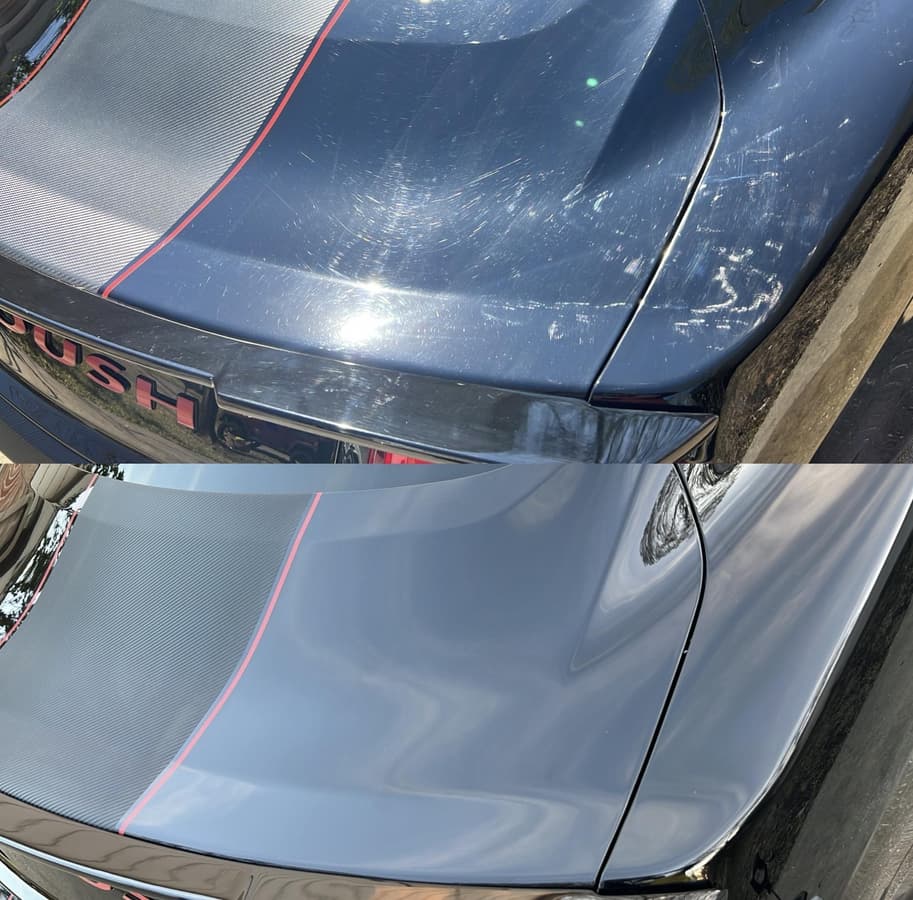
PPF applied over scratches and swirl marks locks those defects in permanently — you can see them under the film. Ceramic coating applied over contaminated or swirled paint seals in the damage rather than correcting it. Either service on improperly prepared paint is money wasted.
A proper paint correction — removing swirl marks, oxidation, and surface defects before protection is applied — ensures you are protecting paint worth protecting, and that the protective layer bonds to a clean, corrected surface that will look its best for years.
The prep step is the most commonly skipped part of a protection service. It is also the difference between a result that looks extraordinary and one that looks merely adequate.
The bottom line
PPF and ceramic coating are not competing products — they are complementary tools that address different threats.
- Rock chips and physical impact: PPF is the only solution
- UV, chemicals, water spots, ease of maintenance: Ceramic coating wins
- Maximum long-term protection: Both, starting with correct paint prep
Houston’s specific combination of highway debris, hard water, intense UV, and high-humidity acid rain environment makes quality paint protection more valuable here than in most other U.S. markets. The cars that maintain their finish in this city are the ones that were protected correctly from the start.
If you are weighing options for your vehicle, we are happy to talk through what makes sense given your vehicle, how you use it, and what you want to protect. Request a quote or book directly — we serve all of Houston and the surrounding areas including Katy, Sugar Land, The Woodlands, Pearland, and River Oaks.