You’ve done the smart thing. You invested in a ceramic coating — maybe as part of a Transformation detail, maybe as a standalone application on a new vehicle you wanted to protect from day one. You paid for the prep work, the paint correction, the proper application, and the cure time. The coating is locked in.
Now what?
Here’s the part most detailing shops don’t spend enough time explaining: a ceramic coating is a long-term protection system, not a maintenance-free shield. The coating won’t wash off in the rain or fail after a car wash — but how you care for it determines whether it performs at year five the way it performed at year one, or whether it degrades into a contaminated, water-spotted mess that stops beading entirely.
In Houston, the maintenance stakes are even higher. The UV index here runs 8–10 from March through October. Surface temps on a dark car in direct sun can hit 175–180°F. Humidity is consistently 70–90%. Industrial fallout from the Ship Channel corridor and petrochemical plants deposits acidic contamination across the metro area year-round. These factors don’t defeat a properly applied ceramic coating — but they do expose any maintenance gaps fast.
What a ceramic coating actually needs from you
Before getting into specific care steps, it helps to understand what a ceramic coating is doing so you know what to protect.
A properly applied ceramic coating forms a semi-permanent glass-like layer over your paint. It’s chemically bonded — it’s not a wax sitting on top of the surface. This layer does several things simultaneously: it blocks UV radiation before it reaches the clear coat, it creates a hydrophobic surface that causes water and contaminants to sheet off rather than bond, and it provides a sacrificial layer that takes minor abrasion, chemical exposure, and environmental fallout instead of your clear coat taking it.
The coating degrades slowly over time through two primary mechanisms: physical abrasion (washing, wiping, contact with road debris) and chemical contamination (industrial fallout, bird droppings, tree sap, brake dust that bakes onto the surface in heat). Maintenance is about slowing both processes.
Washing: the biggest variable in coating longevity
More ceramic coatings fail early from improper washing than from anything else. This is where most people go wrong.
Avoid automated car washes. Tunnel washes with spinning brushes are abrasive — they create fine swirl marks and micro-scratches that dull the coating’s clarity over time. They also use recycled water and harsh detergents that aren’t pH-neutral. Even “touchless” automated washes use high-pressure sprays with strong alkaline chemistry. Neither is appropriate for a coated vehicle.
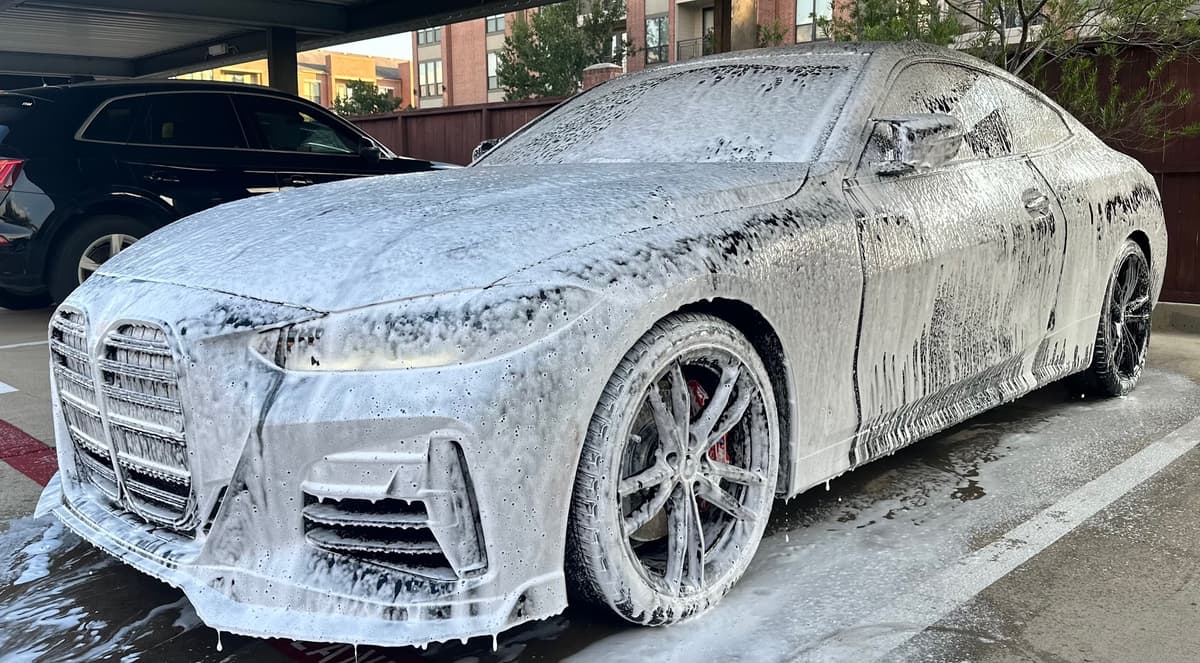
The correct method is hand washing, always. Two-bucket method: one bucket of pH-neutral car shampoo, one bucket of clean rinse water. Wash from the top down using a soft microfiber wash mitt. Rinse the mitt in the clean bucket before reloading with shampoo. This keeps the dirt you’re removing out of the wash bucket and off the paint.
Wash frequency in Houston: Every one to two weeks is the right target here. Houston’s combination of road grime, industrial fallout, pollen (some of the highest counts in the country), and summer thunderstorm residue means the surface picks up contamination fast. Letting that contamination sit bakes it into the coating surface in summer heat and makes it progressively harder to remove without aggressive decontamination.
Post-wash drying: Never let a coated car air dry. Water in Houston is hard — it contains minerals that leave deposits when the water evaporates. Those deposits etch into the coating over time and eventually create the white-hazed water spot pattern that requires decontamination to remove. Use a clean, plush microfiber drying towel or a dedicated car dryer. Wipe in straight lines — not circles.
pH-neutral products only
This is non-negotiable with a ceramic coating. Alkaline products (most conventional car wash soaps, household dish soap, some spray detailers) will degrade the coating’s chemistry over time. Acidic products will do the same. You need pH-neutral or specifically coating-safe products for every product that contacts the surface.
This includes:
- Car shampoo — pH-neutral, labeled “coating safe” or “SiO₂ safe”
- Spray detailer / quick detailer — for between-wash touch-ups; must be labeled coating-safe
- Wheel cleaner — wheels are often ignored but they’re part of the same system; use pH-neutral
- Bug and tar remover — use only when needed; must be solvent-free and coating-safe
What to avoid: dish soap (strips the coating), “all-in-one” wash-and-wax products (deposit product that clouds the coating), heavy degreasers, any product with high pH.
The ceramic coating top-up: SiO₂ spray sealant
One of the most effective — and underused — maintenance steps for a ceramic coating is applying a ceramic spray sealant or SiO₂ spray booster on a regular basis.
These products are designed specifically to be used over an existing coating. They bond to the ceramic layer, replenish the hydrophobic properties, and add a sacrificial layer of fresh protection. Think of it as an oil change for your coating: you’re not replacing the coating, you’re refreshing its surface performance.
Application schedule: Every two to three months is a reasonable cadence in Houston’s climate. Some detailing enthusiasts apply it monthly during the summer peak. Application is simple — spray onto a clean, dry surface and wipe in, panel by panel. A quality SiO₂ spray sealant takes about 30 minutes to apply to a full vehicle.
Look for products specifically labeled “ceramic boost,” “SiO₂ spray,” “ceramic top coat spray,” or “coating maintenance spray.” Do not use a standard paste wax or polymer sealant over a ceramic coating — these products are designed for bare paint and can leave residue that clouds the coating.
Decontamination: addressing what washing can’t remove
Even with perfect washing habits, contamination builds up on a ceramic-coated surface over time that a standard wash won’t remove. Iron particles from brake dust and road debris embed in the coating. Industrial fallout bonds to the surface. Tree sap and bird droppings, if left too long, etch into the coating layer.
Houston-specific contamination sources are significant:
- Brake dust — especially in stop-and-go Houston traffic; iron particles are hot when they land and partially embed in any surface
- Industrial fallout — particularly in areas downwind from the Ship Channel or petrochemical plants; this is airborne ferrous and chemical contamination that deposits invisibly on paint
- Tree sap — oak, pine, and Bradford pear are common; sap becomes increasingly difficult to remove as it bakes in summer heat
- Bird droppings — uric acid content; at Houston surface temps, they etch into unprotected surfaces within hours; coatings provide a buffer but the droppings should still be removed quickly
Iron decontamination (using a pH-neutral iron remover spray) should be performed every three to six months. The product reacts with embedded iron particles and turns purple-red as it dissolves them. Rinse thoroughly after. This is a standard maintenance step, not a sign something is wrong with your coating.
Clay bar or clay mitt can be used on a coated surface periodically to remove bonded surface contamination the iron remover doesn’t address. Use clay sparingly — it is mildly abrasive — and only with appropriate clay lubricant.
What to do about bird droppings and tree sap immediately
Don’t let these sit. In Houston’s heat, bird droppings become highly concentrated as water evaporates — the uric acid content increases significantly and begins etching faster than in cooler climates. Tree sap likewise becomes increasingly viscous and bonded in heat.
Bird droppings: Remove as soon as possible. Mist with clean water, let soften for 30 seconds, then gently lift with a damp microfiber cloth. Do not rub dry. If the dropping has dried and crusted, apply a coating-safe quick detailer or a diluted cleaning spray, cover with a damp microfiber for two to three minutes, then gently wipe. Check the coating surface after removal — if there’s a faint shadow or haziness, schedule a professional inspection.
Tree sap: Fresh sap can often be removed with a dedicated sap remover or isopropyl alcohol applied carefully with a microfiber cloth. Baked sap may require professional decontamination. Do not scrape or use fingernails — this damages the coating.
Annual professional inspection and maintenance detail
Even with perfect at-home maintenance, a ceramic coating benefits from a professional inspection and maintenance detail once a year. This is separate from full reapplication — it’s a check on coating performance and a professional-grade decontamination and boost.
A professional annual maintenance detail typically includes:
- Thorough wash and dry
- Iron decontamination and clay decontamination
- Inspection of coating performance (water bead contact angle, surface hardness)
- Identification of any areas where the coating has been compromised (usually from swirl marks, chip damage, or localized chemical exposure)
- Professional-grade SiO₂ ceramic boost application
- Review of any areas requiring spot correction or partial recoat
In Houston’s climate, this annual maintenance protocol is what separates a coating that performs well at year three and four from one that looks dull and has lost its hydrophobic properties entirely.
Warning signs your coating needs professional attention
Between annual inspections, watch for these indicators:
Water no longer beads properly. Fresh water on a healthy ceramic coating forms tight beads (high contact angle) and sheets off quickly. If water is starting to spread and sheet slowly rather than bead, the coating’s hydrophobic properties are degrading — either from contamination, abrasion, or coating wear.
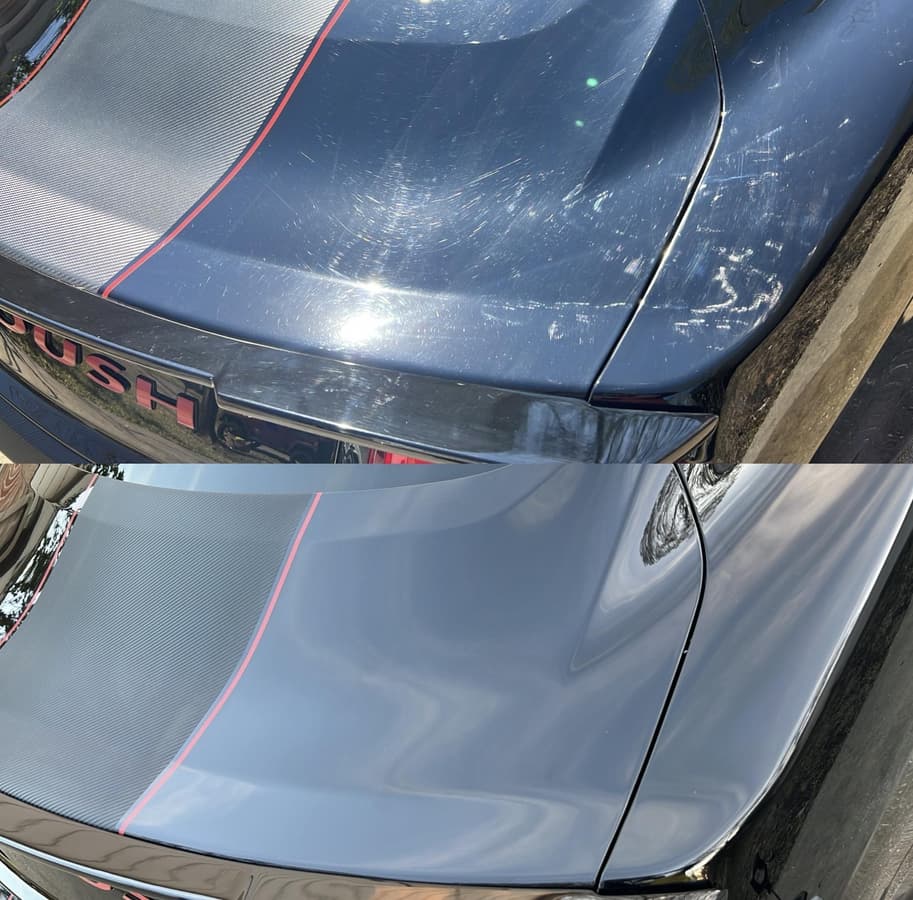
Swirl marks and fine scratches appearing. These indicate the coating surface has been abraded, usually from improper washing or automated car wash contact. Minor swirling can sometimes be addressed with professional machine polishing and coating boost; significant marring may require spot recoat.
Water spots that don’t wipe off. Persistent water spots that remain after washing indicate mineral deposits have etched into the coating. This requires professional decontamination and possibly light polishing.
Coating has aged past its original warranty window. Most professional-grade ceramic coatings carry 2–5 year warranties depending on product tier. As the coating approaches or passes this window, inspect carefully and consider a professional assessment of whether a full recoat makes more sense than continued maintenance.
Ceramic coating in Houston: the investment math
A professional ceramic coating on a standard vehicle, properly applied with full paint correction and prep, runs in the range of several hundred to several thousand dollars depending on vehicle size, paint condition, and product tier. Applied correctly and maintained properly, a high-quality coating lasts three to five years — sometimes longer.
Over that time, compare the cost against regular wax applications (four to six per year at $50–$150 each for professional application, $30–$60 in product cost for DIY), paint correction needs that build up on unprotected paint over time, and potential clear coat damage from Houston’s UV exposure. The economics of a ceramic coating are strongest for drivers who plan to keep their vehicle long-term and want to minimize the total cost of paint maintenance over time.
The coating does that job well. But only with proper maintenance.
CarPlay Mobile Detail applies professional ceramic coatings as part of the Transformation package and provides annual ceramic maintenance details across Houston and surrounding areas. Serving Katy, Sugar Land, The Woodlands, Pearland, Cypress, and Spring. Contact us for a free quote or book a detail directly.
Related articles: