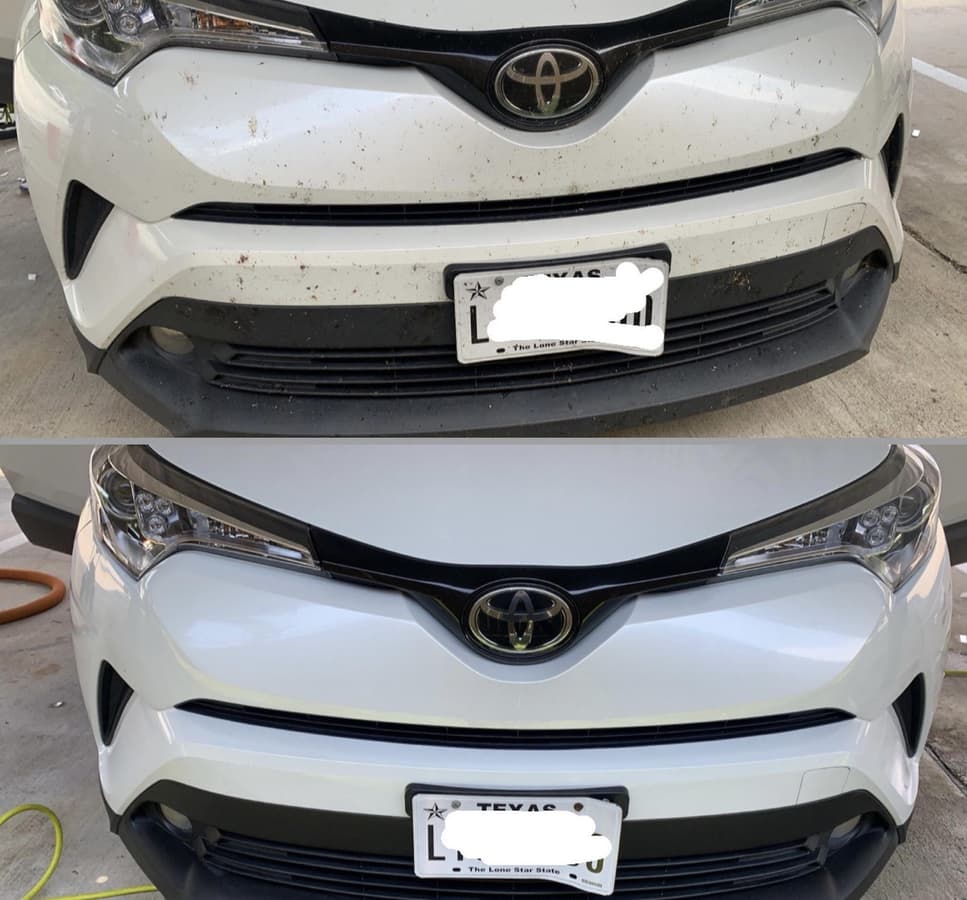
If you’ve owned a car for more than three or four years in Houston, you’ve almost certainly noticed your headlights starting to go yellow. That milky, oxidized film isn’t cosmetic — it’s real damage — and Houston’s climate turns it from a slow creep into a six-month problem.
This guide explains exactly what causes headlight oxidation, why Houston accelerates it faster than almost anywhere else in the country, what the DIY kits actually do (and where they fail), and what professional headlight restoration looks like when done correctly.
Why headlights turn yellow in the first place
Modern headlight lenses are made from polycarbonate plastic — a lightweight, shatter-resistant material that replaced glass decades ago. Polycarbonate is durable in most ways, but it has one significant weakness: ultraviolet light.
From the factory, headlight lenses are coated with a thin UV-protective film. This coating keeps the polycarbonate clear and glossy. Over time — and faster in high-UV environments — that coating breaks down. Once it degrades, UV rays begin attacking the polycarbonate itself, causing a chemical process called photo-oxidation. The surface becomes porous at a microscopic level, trapping particles and scattering light instead of transmitting it cleanly.
The result is the yellow, hazy film you see on millions of cars. It starts at the surface, but if left untreated, the oxidation works progressively deeper into the lens material.
Houston is one of the worst cities in the country for headlights
The speed of headlight degradation is directly tied to UV exposure — and Houston gets a lot of it. The city averages roughly 204 sunny days per year, with UV index readings regularly reaching 8–10 (classified “very high” to “extreme”) from March through October.
Add in Houston-specific factors and the problem compounds quickly:
Heat amplifies UV damage. UV oxidation is a photochemical reaction, and heat accelerates chemical reactions. When a car sits on a Houston parking lot or driveway through a July afternoon with surface temps well above 150°F, the rate of lens degradation increases significantly compared to cooler climates.
Humidity doesn’t help either. While UV is the primary driver, high humidity contributes to surface hazing by encouraging microparticle adhesion to the degraded lens surface. Houston’s average relative humidity of 75–80% means lenses rarely get a dry period that might otherwise slow surface buildup.
Sun angle matters. Houston’s latitude means the sun sits high for most of the year, with direct front-facing exposure hitting headlights that face forward or upward. This maximizes the UV load on lens surfaces compared to northern states where sun angles are lower.
The practical result: cars in Houston often show significant headlight hazing within 3–4 years of manufacture. In states like Minnesota or Oregon, the same vehicle might take 6–8 years to show comparable degradation.
What cloudy headlights actually cost you
The cosmetic impact is obvious, but the functional consequences are real too.
A study by the AAA found that severely oxidized headlights can reduce light output by up to 80%. A headlight emitting 20% of its designed illumination is effectively a parking light. Night visibility is compromised — reaction time to road hazards decreases — and the car looks neglected regardless of how clean everything else is.
There’s also a resale impact. Cloudy headlights are one of the first things buyers and dealers assess. A set of yellowed lenses signals deferred maintenance and ages the vehicle visually. On a pre-sale detail, headlight restoration is almost always worth doing because it changes the perceived age of the car more dramatically than almost any other single service.
And in Texas, there’s a practical safety inspection concern. Severely degraded headlights can fail state inspection if they don’t meet minimum light output requirements.
What DIY headlight restoration kits actually do
Walk into any auto parts store and you’ll find headlight restoration kits ranging from $10 to $40. Most work on the same basic principle: abrasive compounds that sand the oxidized layer off the lens surface, followed by a polish to restore clarity.
These kits genuinely work — in the short term. Immediately after a DIY restoration, the headlights look dramatically clearer. The problem is what comes next.
DIY kits don’t include a UV-protective coating. Once you sand off the original factory film, the polycarbonate is completely bare and more vulnerable to UV than it was with even degraded original coating. Without reapplication of a UV sealant or coating, the lens begins re-oxidizing almost immediately. In Houston’s UV environment, many DIY kit results last less than six months before the hazing returns — sometimes worse than before because deeper into the lens is now exposed.
This creates a cycle: sand, polish, looks good, fades, sand again, polish again. Each sanding cycle removes a small amount of lens material. Eventually the lens is too thin to sand further, or the hazing becomes internal rather than surface-level, and the only option is lens replacement.
The difference with professional restoration
A professional headlight restoration follows the same fundamental process — abrasive cutting, polishing — but does it at a finer, more controlled level, and critically, finishes with a UV sealant or coating application.
Here’s what a professional process typically looks like:
Wet sanding with progressively finer grits. Professional restoration starts with wet sanding using multiple grit levels — typically 800, 1000, 1500, 2000, and finishing with 3000+ — before moving to compound and polish. This removes oxidation more completely and produces a cleaner base for the final finish compared to the single abrasive compound most kits provide.
Multi-stage machine polishing. Using a dual-action or rotary polisher with diminishing abrasive compounds eliminates the haze left by wet sanding and brings the lens back to optical clarity. Hand polishing, which is what most DIY kits assume, rarely achieves the same result.
UV sealant or coating application. This is the critical step DIY kits skip. Professional restoration finishes with a dedicated UV-blocking sealant, ceramic-based coating, or in some cases a spray PPF product applied over the lens. This re-establishes the protective barrier that prevents re-oxidation. Done correctly, professional headlight restoration results last 2–4 years in Houston conditions — four to eight times longer than a DIY kit result.
Masking and paint-safe technique. Professional work protects the surrounding paint and trim during the process. DIY kits often result in compound residue on painted surfaces adjacent to the lens.
When restoration isn’t enough
There’s a point at which headlight oxidation is too deep to sand and polish away. If hazing persists after polishing — meaning the damage has penetrated beyond the lens surface into the bulk polycarbonate — restoration isn’t effective. The lens needs replacement.
A professional technician can assess this before starting work and tell you upfront whether restoration will deliver a good result or whether replacement is the better option. This saves you paying for restoration on a lens that won’t respond, and gives you honest expectations.
Headlight restoration as part of a full exterior detail
Headlight restoration is almost always done as part of a broader exterior detailing service rather than as a standalone appointment. The same wet-sanding, polishing, and protection process overlaps significantly with paint correction and exterior paint care — the tools, compounds, and techniques are similar.
When done during an exterior detail or Transformation service, headlight restoration adds minimal additional time while delivering a significant visual upgrade. The lenses are already exposed, the area is clean, and the polishing equipment is already out.
This is why CarPlay’s detailing packages often include headlight restoration as part of the exterior scope — it’s part of a complete paint and exterior assessment, not a separate upsell.
What to look for when evaluating your headlights
Here’s a quick self-assessment:
Stage 1 — Surface film: Light yellowing, some loss of gloss. Still transmits most light. DIY kit or professional polish will restore clarity, though professional finish lasts significantly longer in Houston conditions.
Stage 2 — Moderate oxidation: Pronounced yellowing, milky appearance, visible pitting or micro-cracking at the surface. Light output measurably reduced. Professional restoration with UV coating recommended.
Stage 3 — Deep oxidation: Heavy hazing that doesn’t respond to surface abrasion, internal crazing or cracking, or opaque white patches. Likely lens replacement territory. Professional assessment required before attempting restoration.
If you’re unsure which stage your lenses are in, the best approach is an honest evaluation from a detailer who’ll tell you straight — restoration when it’ll work, replacement recommendation when it won’t.
Book headlight restoration in Houston
CarPlay Mobile Detail handles headlight restoration as part of exterior detailing across Houston and surrounding areas. We come to you — no drop-off, no waiting room, no driving on compromised headlights.
Whether you need a quick exterior refresh or a complete Transformation package that includes paint correction, ceramic coating, and full interior restoration, we’ll give you an honest assessment of what your headlights need and what results you can expect.
Get a quote for exterior detailing or book directly through our scheduling system.
We serve Houston, Katy, Sugar Land, The Woodlands, Pearland, Cypress, Spring, and surrounding areas. Mobile service — we bring the detail to your driveway, office, or anywhere convenient.