Why Cleaning Your Car’s Interior in Houston Is Different
In most cities, a quick wipe-down and vacuum handles routine interior maintenance. In Houston, that’s not enough.
Here’s what you’re fighting:
- Heat: Dashboards and steering wheels hit 160–185°F in direct sun. Heat bakes odors into foam and fabric and accelerates plastic off-gassing — that “new car smell” that turns chemical and stale.
- Humidity: Year-round 75–90% relative humidity creates the perfect environment for mildew in carpet backing, under-seat foam, and HVAC ducting. Once mildew takes hold in fabric, a vacuum won’t touch it.
- Pollen: Houston’s pollen season runs nearly year-round. Fine particles embed in seat fabric and carpet fiber and trigger allergies every time the AC kicks on.
- AC moisture: The evaporator coil cycles through condensation daily. If drainage is partial, mold grows inside the HVAC box — and blows directly at your face.
The techniques that work in Denver or Chicago often fail here. This guide covers what actually moves the needle in Houston’s climate.
The 5-Zone Interior Cleaning System
Professional detailers work in zones to avoid cross-contaminating clean surfaces. Adopt this system and you’ll cut your cleaning time in half.
Zone 1 → Headliner and sunroof Zone 2 → Dashboard, center console, door panels Zone 3 → Seats (driver, passenger, rear) Zone 4 → Carpet and floor mats Zone 5 → Glass (all four windows + windshield)
Always work top to bottom. Debris and product fallout from Zone 1 lands in Zone 4 — not on freshly cleaned seats.
Zone 1: Headliner
The headliner is the most fragile surface in the interior. Most are bonded to a foam substrate with heat-sensitive adhesive.
What works:
- Lightly mist with an upholstery cleaner and blot with a clean microfiber — never scrub
- Use circular, overlapping strokes with minimal pressure
- A foam-tip soft brush (like a makeup brush) removes dust from sun visor fabric without disturbing the bond
What doesn’t:
- Steam at close range (melts adhesive along the edges)
- Scrubbing with a terry cloth or rough sponge (separates the backing)
- Saturating the surface (sagging headliner is almost always caused by moisture)
Houston note: Dark headliner stains near the sunroof seal are almost always mildew from micro-leaks. A surface wipe won’t fix this — the adhesive backing needs professional enzyme treatment before it’s re-bonded.
Zone 2: Dashboard, Console, Door Panels
Hard surfaces look easy but are where most DIY mistakes happen — specifically, using the wrong product for the material.
Identifying your surfaces
Before cleaning anything, identify what you’re working with:
- Soft-touch matte plastic: Found in premium vehicles. Absorbs product and shows fingerprints. Never use silicone-based dressings — they attract dust and create a permanent greasy film.
- Gloss plastic: Center stack, vent rings, piano black trim. Use diluted IPA (isopropyl alcohol, 70%) and lint-free microfiber. Never use all-purpose cleaners — the surfactants leave a haze.
- Leather dash pad: Rare but present on luxury vehicles. Treat like Zone 3 leather.
- Alcantara / suede inserts: Use a dedicated suede brush only. No liquid cleaners unless specifically formulated for alcantara.
Step-by-step for hard surfaces
- Use a soft detailing brush to loosen dust from vents, gaps, and buttons before any product
- Vacuum the loosened debris
- Apply interior cleaner to your microfiber — not the surface — and wipe
- Follow with a matte interior dressing (not Armor All) for plastic UV protection
Houston heat consideration: UV degradation happens fast on exposed dashboards. An unprotected dashboard in Houston cracks and fades within 2–3 years. A UV-blocking matte dressing applied quarterly extends dashboard life significantly and prevents the chalky, cracked look common on high-mileage Houston cars.
Zone 3: Seats
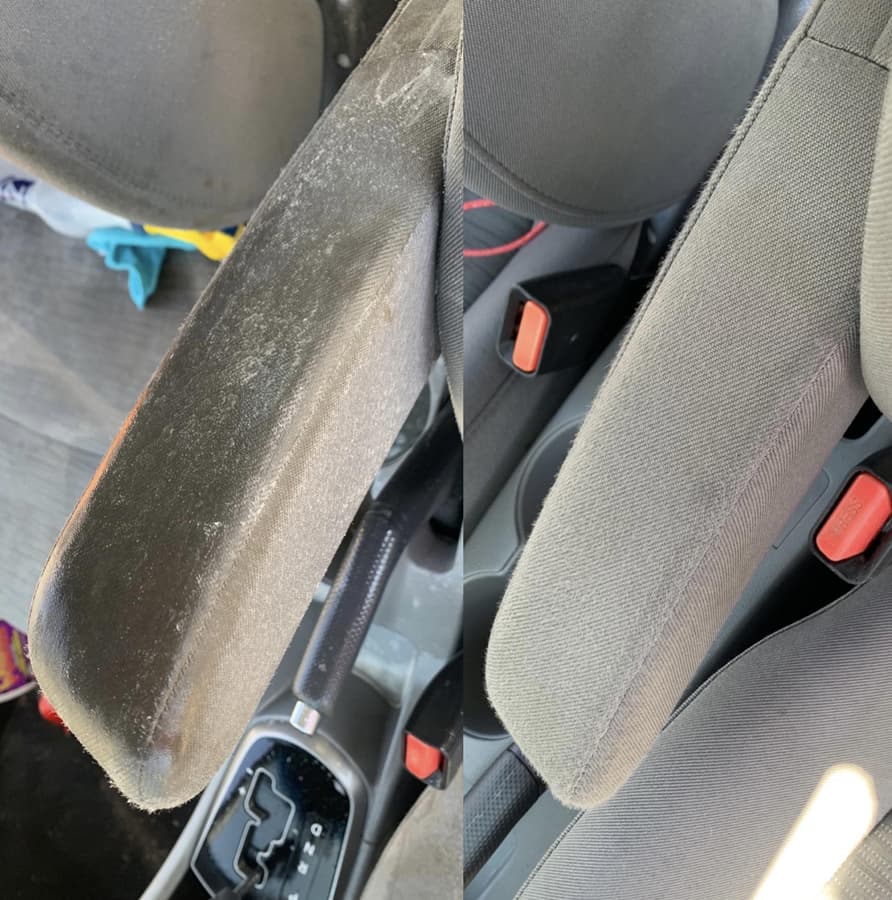
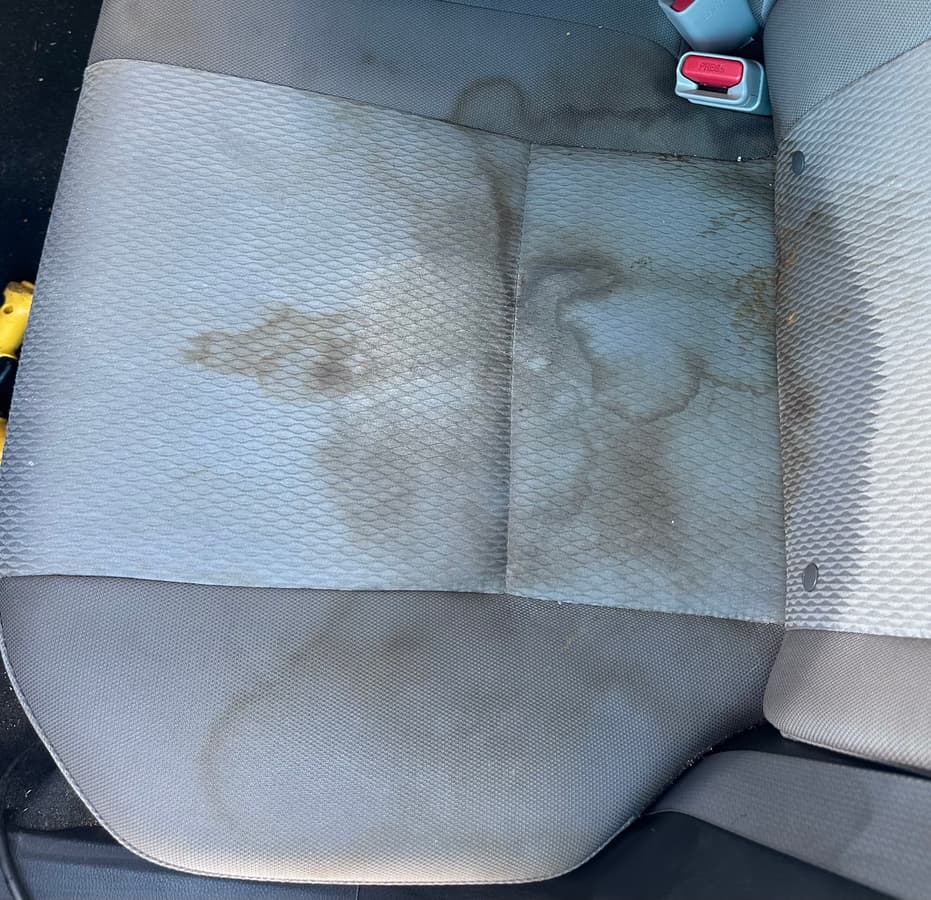
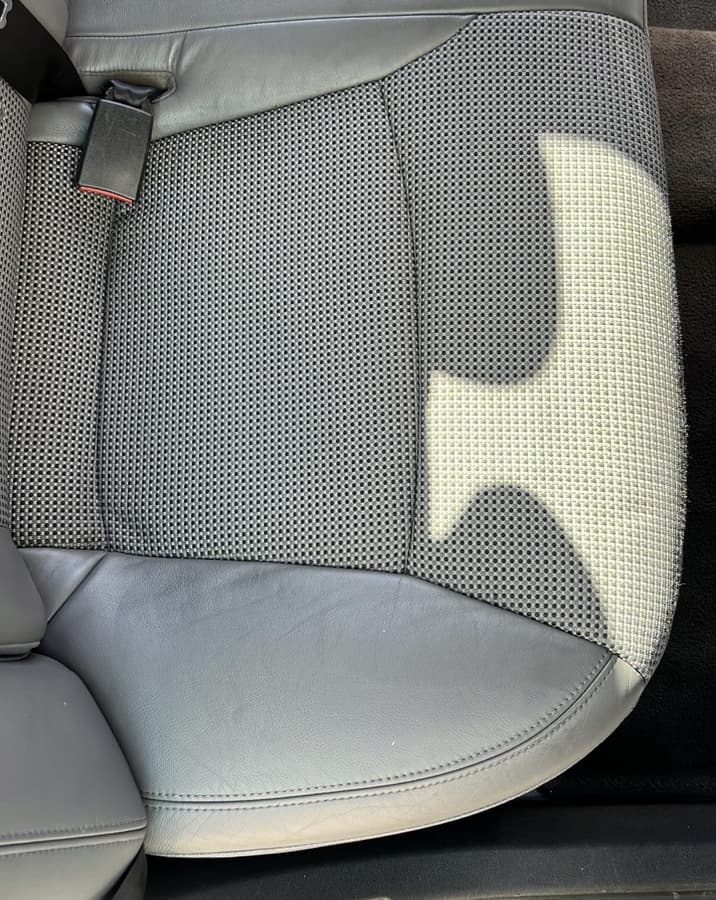
Fabric / cloth seats
Fabric seats in Houston accumulate sweat salts, skin oils, and Houston’s fine dust in layers. These compounds bond to fiber and require agitation — not just extraction — to release.
DIY steps:
- Vacuum with an upholstery attachment (slow, overlapping passes — not fast swipes)
- Lightly mist with diluted upholstery cleaner (1:4 concentrate-to-water)
- Agitate with a soft-bristle brush in a circular motion
- Blot with a clean microfiber — never rub
- Let dry completely before sitting (critical in Houston — damp fabric mildews overnight)
Houston heat tip: If you’re cleaning seats in summer, do it before 10 AM or after 6 PM. Mid-day heat dries product before it can penetrate, leaving white residue.
Leather seats
Leather requires a two-step process that most DIYers skip: cleaning first, conditioning second. Applying conditioner over dirty leather seals contaminants into the pores.
DIY steps:
- pH-neutral leather cleaner on a microfiber — wipe in sections
- Buff with a dry cloth immediately (don’t let cleaner sit)
- Apply leather conditioner in thin, even coats
- Buff off excess — greasy leather feels uncomfortable and picks up dye transfer from clothing
What to avoid:
- Baby wipes (pH too high — they strip the protective coating over time)
- Saddle soap (too harsh for automotive leather)
- Silicone sprays (slippery seats are a safety issue and destroy stitching over time)
Houston-specific issue: Perforated leather in Houston heat accumulates sweat and oils deep in the perforations. A soft detailing brush angled across the perforations before cleaning is essential — skip this step and you’ll push the debris deeper.
Zone 4: Carpets and Floor Mats
This is where Houston’s humidity does the most hidden damage.
The smell that keeps coming back
If your car develops a musty smell within a few weeks of cleaning, the source is almost always the carpet backing — the foam layer beneath the visible fiber. Surface extraction cleans the top layer but leaves moisture and biological material in the foam.
The fix: professional hot-water extraction at 210°F+ with enzyme-based cleaners, followed by forced-air drying. This is physically impossible to replicate with consumer steam cleaners or wet-vacs.
DIY carpet maintenance
For routine maintenance between professional details:
- Remove floor mats and beat them against a hard surface before vacuuming
- Vacuum carpet with a stiff-bristle upholstery attachment (angles into fiber better than flat attachments)
- Spot-treat stains immediately — most set within 24 hours in Houston heat
- For fresh stains: blot (never rub), apply diluted APC (all-purpose cleaner), agitate, extract with wet-vac if available, blot dry
- Leave doors open for 20+ minutes after any wet cleaning — Houston’s humidity extends dry time significantly
What to do about the AC drain smell
The musty smell that’s worst when you first start the car is usually the HVAC evaporator. This is not a carpet problem — it’s a microbial colony on your evaporator coil. No amount of carpet cleaning addresses it. The solution is an HVAC fogger treatment pushed through the fresh air intake while the AC runs.
Zone 5: Interior Glass
Interior glass accumulates off-gassing residue (that “haze” on windshields), humidity condensation minerals, and hand oils. Exterior-grade glass cleaners often streak because they’re formulated differently.
What works:
- Two-microfiber method: first pass with glass cleaner to break down film, second pass with a dry microfiber in overlapping S-strokes
- Reach the far corners of the rear window with a foam-wrapped flat applicator
- For stubborn off-gassing haze: diluted IPA (50/50 with distilled water) cuts it faster than most glass cleaners
What doesn’t:
- Paper towels (leave lint; scratch with repeated use)
- Ammonia-based cleaners on tinted windows (degrades the film adhesive over time)
- Cleaning in direct sunlight (streaks from fast evaporation)
DIY Maintenance Schedule for Houston
| Frequency | Task |
|---|---|
| Weekly | Vacuum carpets and seats; wipe dashboard |
| Monthly | Deep wipe all hard surfaces with UV dressing; clean glass |
| Quarterly | Full fabric extraction (or professional service); condition leather; treat HVAC |
| Annually | Full professional interior detail with enzyme treatment, steam extraction, and paint protection review |
When DIY Isn’t Enough: What Professionals Do That You Can’t
Professional interior detailing provides results that consumer products and equipment can’t match:
Hot water extraction at 210°F — Consumer wet-vacs operate at ambient temperature. Professional extractors heat water to 210°F, which kills bacteria, breaks down protein-based stains (blood, sweat, food), and penetrates carpet backing. This is the only reliable way to remove mold from carpet foam.
Industrial-grade enzyme treatments — Consumer enzymatic cleaners are diluted 5–10× compared to professional-grade concentrates. Professional formulations break down odor compounds at the molecular level — not just masking them.
Forced-air drying — After extraction, professionals use high-velocity air movers to dry carpet and seats to under 10% moisture content. This prevents mildew from reforming in Houston’s humidity. Consumer methods leave surfaces damp for 4–12 hours.
Ozone/UV treatment — For severe odors (smoke, pet, mildew), professional ozone generators or UV-C treatment eliminates airborne biological compounds that survive enzyme application.
How to Know When Your Interior Needs Professional Attention
| Sign | What It Means |
|---|---|
| Musty smell that returns within 2 weeks of cleaning | Mold in carpet backing or HVAC — needs enzyme extraction |
| AC smell strongest at startup | Evaporator coil mold — HVAC fogger treatment needed |
| Seat fabric feels stiff or crusty | Sweat salt crystallization — needs hot extraction |
| Leather cracking at seams | Dryness + UV damage — needs conditioning and possible restoration |
| Dashboard developing hairline cracks | UV degradation — may be reversible with correction compound |
| Persistent pet hair after vacuuming | Hair wrapped around carpet fiber — requires rubber brush extraction |
| Stain that lightened but didn’t disappear | Set stain — needs professional agitation + enzyme treatment |
Book a Professional Interior Detail in Houston
CarPlay Mobile Detail brings professional-grade equipment to your driveway, office, or apartment complex — no drop-off required. Our interior details use commercial hot-water extraction, enzyme treatments, and proper drying to address what Houston’s humidity does to your car’s cabin.
See our interior detailing service page for a full breakdown of what’s included in every visit — hot-water extraction, enzyme treatments, leather conditioning, and more.
Service areas: Katy, Sugar Land, The Woodlands, Pearland, Cypress, Spring, Tomball, River Oaks, Galleria, Bridgeland, Towne Lake, and throughout Houston.
Questions? Call or text: (832) 938-2700