Houston summer is not a gentle season. From June through September, daytime temperatures routinely hit 95–105°F with humidity that makes it feel even hotter. UV index values reach 10–11 on clear days — the same level that causes sunburn in under 15 minutes. Tropical downpours dump 2–4 inches of rain in an hour and leave mineral-laden water sitting on your paint. Oak trees, sweet gum trees, and crepe myrtles cover parked cars in sticky sap and pollen.
Every one of these conditions is an active threat to your vehicle’s paint, interior, and glass. Ignoring them does not mean nothing happens — it means damage accumulates slowly until it becomes expensive to reverse.
This guide covers the specific ways Houston summer degrades your car and what you can do about each one before the damage becomes permanent.
What Houston summer actually does to your paint
UV oxidation
Paint is not infinitely durable. The clear coat — the transparent layer over your color coat — absorbs UV radiation every day your car is parked outside. Over time, UV breaks down the chemical bonds in the clear coat. The first sign is loss of gloss: your car starts to look dull, flat, or hazy rather than deep and shiny. If it progresses, the clear coat begins to peel or flake, at which point you are looking at a respray rather than a polish.
Houston’s UV exposure is among the highest in the continental United States. A car that would show oxidation in 7–10 years in Seattle may show the same damage in 3–5 years here. If your car is parked outside without protection, every summer accelerates this process.
What helps: Ceramic coating creates a semi-permanent UV barrier over your paint that dramatically slows oxidation. Regular detailing with a quality wax or sealant provides shorter-term protection that needs to be renewed seasonally.
Bird dropping and tree sap etching
This is the damage that catches Houston car owners most off guard. Bird droppings and tree sap are mildly acidic. In cool weather, you have hours to remove them before they bond to paint. In Houston summer heat, the same contaminants can etch into your clear coat in as little as one to two hours on a hot surface.
The physics are straightforward: heat softens clear coat, the acid penetrates the softened surface, and when the surface cools it hardens around the contaminant. What wipes off in cool weather requires machine polishing to remove in summer — and if left long enough, the etching is permanent.
Sweet gum trees, live oaks, and crepe myrtles — all common in Houston neighborhoods — drop sap and sticky residue throughout summer. If you park under trees, you will deal with this constantly.
What helps: Remove bird droppings and sap immediately — do not leave them to bake. Use a dedicated sap remover or isopropyl alcohol for sap, not a dry cloth (which can scratch). After removal, inspect for etching. Ceramic coating significantly reduces sap and dropping adhesion, making removal faster and etching less likely.
Water spot mineral deposits
Houston’s summer rain is soft water that sounds gentler than it is. When tap water or even rainwater dries on a hot surface, it leaves behind dissolved calcium and magnesium minerals. On a car sitting in Houston summer sun, water droplets from a storm can dry within minutes — fast enough to leave visible white spots before you even walk back to your car.
These mineral deposits are more than cosmetic. Left in place, they bond to paint and glass and require decontamination — sometimes clay bar treatment or chemical dissolvers — to remove fully. On glass, they create permanent hazing that looks like fog from inside the car.
What helps: Dry your car after washing rather than letting it air-dry. For glass, a ceramic glass coating dramatically reduces water bonding and makes wipe-off fast and complete. Regular decontamination treatments as part of a professional detail prevent mineral buildup from reaching permanent levels.
What Houston summer does to your interior
Odor amplification
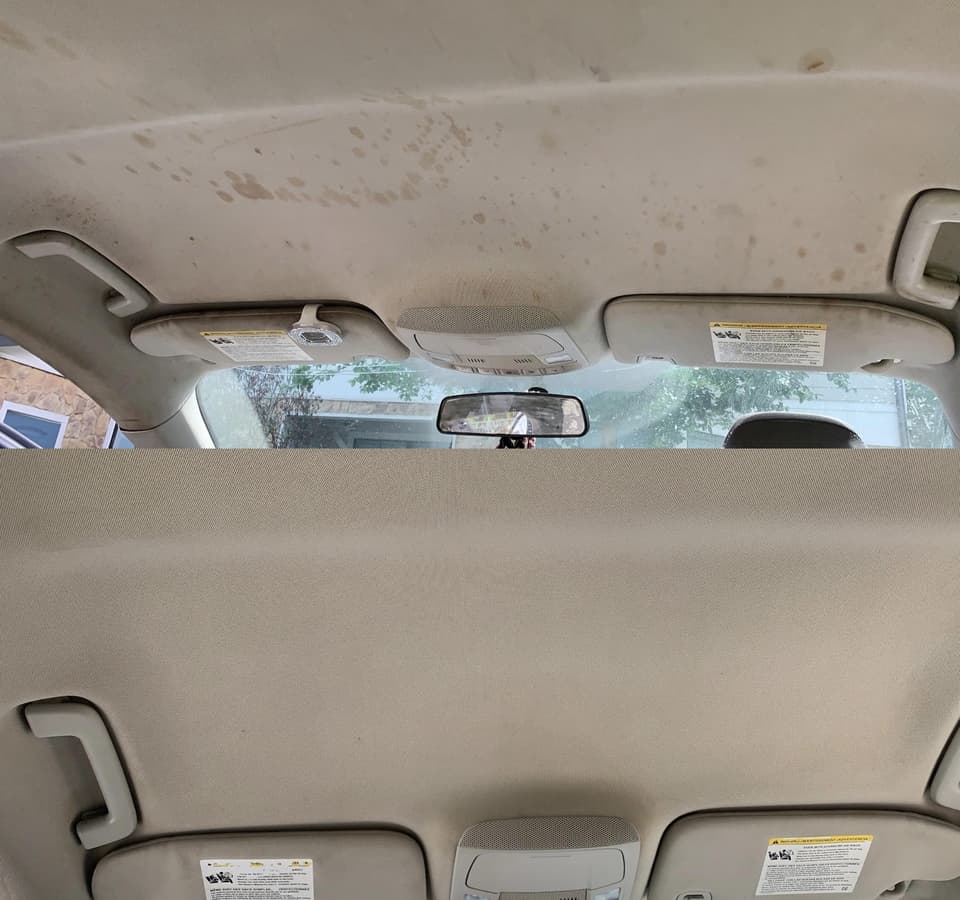
Every car accumulates organic material in the fabric and carpet — food particles, body oil, pet dander, spilled liquids. In mild weather, these sources produce little perceptible odor. In Houston summer, the interior of a parked car can reach 140–160°F. At those temperatures, organic material in fabric actively off-gasses. What smelled faintly unpleasant in April can become strongly unpleasant by July.
This is why odor complaints spike in summer. The car is not dirtier than it was — it is just hotter, and heat forces odor compounds out of materials where they have been sitting quietly for months.
What helps: Professional interior detailing with hot water extraction removes odor sources at the fiber level rather than masking them. This is especially important before summer heat arrives — removing contamination in spring means there is far less material to off-gas in July.
Dashboard and trim degradation
Plastic and vinyl surfaces in direct sun experience extreme thermal cycling — heating to 180°F+ on a parked car and then cooling when the AC kicks on. Over time, this causes dashboards to crack, trim to fade, and plastics to become brittle. UV also breaks down the chemical stabilizers in most plastics, causing them to bleach and chalk.
A cracked dashboard is not just cosmetic — replacement on modern vehicles can cost $800–$2,500 depending on the model.
What helps: A quality UV-protective dressing applied to interior plastics creates a barrier against UV and thermal degradation. This is a standard part of a full interior detail and takes 15 minutes to apply — far cheaper than dashboard replacement.
Leather and seat degradation
Leather seats in Houston summer face dual threats: UV fading and dehydration. Genuine leather dries out in extreme heat and becomes brittle. Without regular conditioning, fine cracks appear first in high-contact areas, then deepen into full splits. Once leather splits, repair requires either panel replacement or professional leather reconditioning — neither is cheap.
What helps: Leather conditioning every 3–4 months, and more frequently in summer. A professional detail that includes leather treatment applies the right products without over-saturating or leaving surfaces greasy.
The glass problem in summer
Houston summer creates a specific glass issue that most drivers notice but rarely connect to season: interior glass hazing. When a car heats to 140°F+, plastic off-gassing from the dashboard, door panels, and headliner deposits a thin film on the inside surface of every window. This is the haze that makes interior glass look foggy, especially visible when driving toward the sun in the afternoon.
This film does not wipe off with a paper towel or a standard glass cleaner. It requires a dedicated glass cleaner with the right surfactants applied with a clean, lint-free cloth in two passes — one to cut the film, one to polish. Done correctly, glass becomes optically clear. Done incorrectly (with inferior products or dirty materials), you simply redistribute the film and create smears.
What helps: A complete glass cleaning is part of every professional interior detail. Glass-specific ceramic coating applied inside and out dramatically reduces film accumulation and makes subsequent cleaning faster.
A realistic summer car care schedule for Houston
Before summer (April–May):
- Full detail to remove winter and spring contamination — road film, pollen, sap
- Apply paint protection (wax, sealant, or ceramic coating) before peak UV season
- Leather conditioning
- Interior hot water extraction if any odor is present
Mid-summer (June–August):
- Wash every 1–2 weeks — do not let sap, bird droppings, or water spots bake in
- Remove any bird droppings or sap immediately (same-day when possible)
- Quick interior wipedown of high-contact surfaces
- Professional detail if the car has been driven heavily, spent extended time parked outside, or has visible paint or odor issues
After summer (September–October):
- Post-summer decontamination to remove mineral deposits and any UV-accelerated surface contamination
- Reapply wax or sealant if not ceramic-coated
- Full interior detail to address anything summer heat amplified
Why mobile detailing is particularly practical in Houston summer
Bringing your car to a detail shop in July means you have to wait in the heat, return in the heat, or arrange a ride and pick up in the heat. It also means your car sits exposed in a shop’s outdoor lot for part of the process.
Mobile detailing solves the logistics problem summer creates. CarPlay Mobile Detail comes to your home, office, or wherever your car is parked. You stay in the air conditioning. Your car gets detailed where it already is. There is no drop-off, no wait at a shop, no second trip in 95°F weather.
This matters more in summer than at any other time of year.
The long-term cost of skipping summer protection
The math on deferred car care is not favorable. A full detail in May costs $200–$300. Ceramic coating that provides multiple summers of UV and contaminant protection costs $1,000–$2,000 depending on the package and vehicle size — but lasts 3–5 years. A paint correction to reverse oxidation and UV damage costs $800–$1,500. Dashboard replacement runs $800–$2,500. Leather reconditioning for seats that cracked from sun and heat exposure: $400–$1,200.
The math is simple: protection is far cheaper than repair.
CarPlay Mobile Detail serves Houston and surrounding areas including Katy, Sugar Land, The Woodlands, Cypress, Spring, Pearland, Bridgeland, and Towne Lake. If your car has spent this spring parked outside accumulating Houston environmental damage, now — before the worst of summer — is the right time to address it.
Get a quote or book an appointment to schedule service before the July heat peak arrives.
For more on protecting your investment, see our guides on ceramic coating, paint correction, and interior detailing.